
Tongan Tattoo History | Tatatau Revival | Tukufakaholo | King ’Afa Cocker
Updated: Aug 15
From Ancient Tonga to the Diaspora, the Modern Revival, and the Next Stage of Tongan Tattoo Refinement
By King ’Afa Cocker Cultural Tattoo Artist, Researcher, Archivist & Creative Director
Long before Polynesian tattoo became a global visual language—before Instagram, tattoo conventions, celebrity sleeves, online pattern libraries, or the modern Polynesian tattoo market—Tonga possessed its own tattoo tradition.
That history is no longer a matter of speculation.
Four ancient bone tattooing combs excavated on Tongatapu in the 1960s were later scientifically dated to approximately 2,700 years ago. https://www.npr.org/2019/03/08/700486740/making-a-mark-ancient-tonga-tattoo-tools-may-illustrate-birth-of-polynesian-body
Geoffrey Clark of the Australian National University and Michelle Langley of Griffith University identified them as the oldest confirmed multi-toothed tattooing implements yet found in Oceania. The collection originally included an ink vessel, creating what researchers describe as the oldest complete tattooist's kit yet documented.
The significance is enormous.
Tongan tattoo history does not begin with the internet.
It does not begin with contemporary tattoo studios.
It does not begin with a university thesis.
And it does not begin with the twenty-first-century revival.
Its archaeological roots reach back toward the formation of Polynesian civilization itself.
For me, however, the history of Tongan Tātatau is not only archaeology.

It is also Tukufakaholo—the transmission of history, culture, knowledge, practice, language, genealogy, responsibility and memory from one generation to another.
That distinction has shaped nearly three decades of my work.
Tongan Tattoo History | Tatatau Revival | Tukufakaholo | King ’Afa
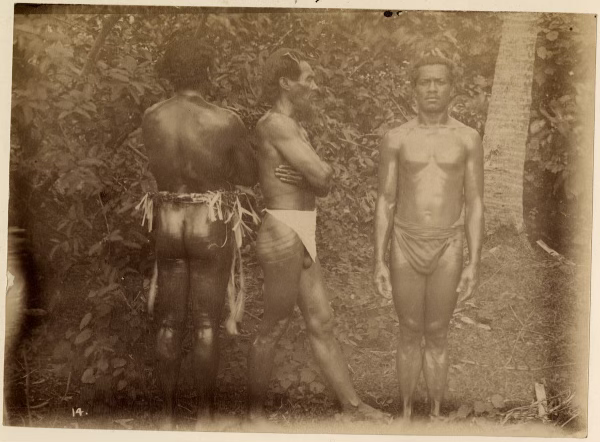
Early European records make clear that tattooing existed among Tongans before its nineteenth-century suppression.
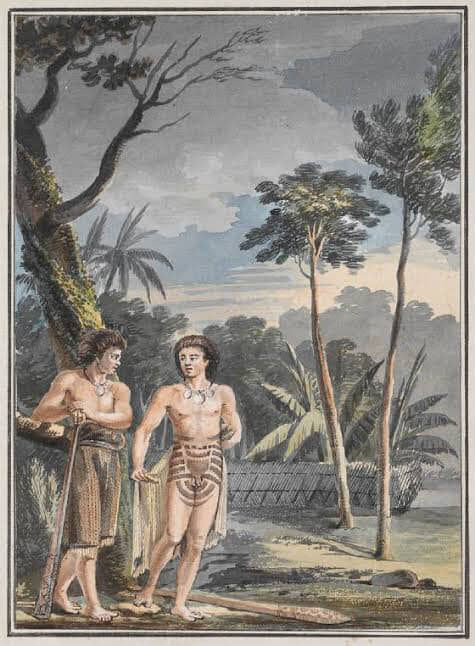
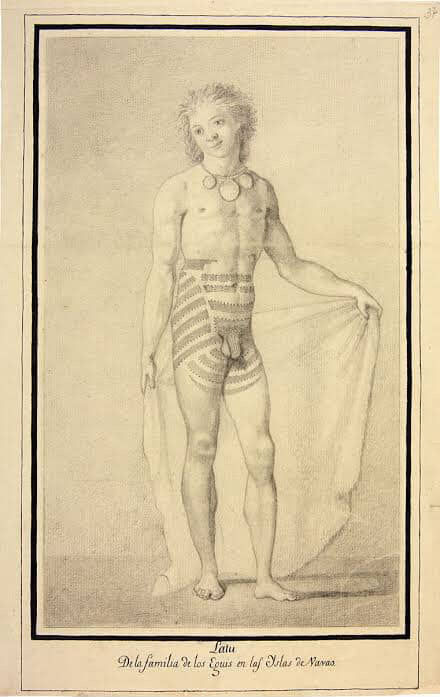
Accounts describe tattooed Tongan men and women. Captain James Cook recorded tattooing on the arms, hands and fingers of women on Tongatapu in 1773. Vice-Admiral William Waldegrave later observed tattooing on women's legs and feet in Vava‘u. Earlier European descriptions recorded tattooed or heavily marked Tongan men, while artist Louis-Auguste de Sainson documented a detailed Tongan male thigh tattoo during the 1820s voyage of Jules Dumont d'Urville. https://collections.tepapa.govt.nz/object/1417097?page=1&rtp=1&ros=1&asr=1&assoc=all&mb=c

This matters because one of the most persistent misunderstandings in the modern Polynesian tattoo market is the belief that historical Tongan tattooing was simply Samoan tatau under another name. Most Tongans today wear Tongan Tattoo Faa Samoa including their Tatau by Samoan Tufuga.
The Tonga - Samoa - Fiji histories are related. The Pacific islands interacted. Technologies, people and knowledge travelled throughout Oceania.
But Tongan Tātatau has its own historical record, its own relationship to our Tukufakaholo, its own social history and its own visual evidence.
A Tongan wearing a Samoan-structured tatau is not automatically wearing a reconstructed historical Tongan tātatau simply because Tongan motifs have been inserted into it.
That distinction is central to the work I continue today.

1839: When Tongan Tātatau Was Suppressed
Tongan tattooing suffered a major rupture during Tonga's nineteenth-century Christian transformation.
The Vava‘u Code of 1839, instituted under ruler Tāufa‘āhau—later King George Tupou I—criminalised tātatau along with other cultural practices such as serfdom and cannibalism judged incompatible with the developing Christian political order. Legal scholarship on the Code identifies the abolition of tātatau as part of that transformation.
Yet prohibition did not erase historical memory completely.
A Wesleyan missionary writing on Tongatapu in 1849 recorded encountering Tongans still practicing tātatau. When challenged, they answered with words translated as:
“It is the way of our country.”
The account is important because it locates tattooing not merely on the skin but within fonua—people, place, land and identity.
The practice diminished.
The memory fragmented.
But the history did not disappear.
Tukufakaholo: History That Is Lived
My approach to Tongan Tattoo History Tatatau Revival Tukufakaholo - was never based only on collecting random Tongan patterns.
A pattern without its historical framework can become decoration.
Tukufakaholo is different.
I use the word to describe the living transmission of Tonga's history and culture: learning through ancient wisdom of matu'a elders, kainga, language, genealogy, social relationships, ceremony, observation, responsibility and lived experience.
That includes understanding Tohi Hohoko—Genealogy and Lineage—and the place of kainga - family within Tonga's different Clan - Ha‘a, as well as the historical worlds surrounding the Tu‘i Tonga Empire, Tu‘i Ha‘atakalaua Rule and Tu‘i Kanokupolu Dynasties.
Academic history and Tukufakaholo should not be confused.
A historian may obtain a bachelor's degree, master's degree or doctorate through archival study, research methodology, writing, thesis work and dissertation peer review. Those disciplines have value.
But a University College degree does not automatically create a tufunga.
Likewise, being a tattoo mastery artist practitioner does not automatically make someone a rigorous historian.
The strongest future for Tongan cultural knowledge requires both documentation and lived transmission—not the destruction of one system by the other.
What concerns me is the modern tendency to separate Tongan patterns from the social structures that produced them.
Ancient kupesi were not designed for Pinterest.
They were not invented as downloadable tattoo graphics.
They emerged from a functioning civilization.
The challenge today is not simply to reproduce them.
It is to understand what they belonged to.

1996–2001: Before “Tongan Tattoo” Became a Market
My relationship with tattoo did not begin after Polynesian tattoo became commercially popular.
During the 1990s in Tonga, I was already drawing cultural artwork for friends and for school and cultural activities.
I began receiving tattoos in Tonga in 1998 and 1999. Those early tattoos arm bands were classify as part of our Tongan cultural performance.
By 2000 and 2001, while living in Kuala Lumpur Malaysia, tattoo became increasingly important to the direction of my life.
When I arrived in the United States in Spring 2002, I entered a very different environment.
There was no established modern Tongan tattoo industry waiting for me.
There was no mature social-media marketplace.
There were no thousands of Tongan tattoo reference photographs available instantly through a phone.
The work had to be constructed.
My early archive combined years of studying Polynesian and Pacific visual culture with what I had learned growing up in Tonga, living in Fiji, traveling through the Pacific Islands and speaking with people who carried cultural knowledge of ancient wisdoms.
That eventually developed into a much larger archive covering Tonga, Samoa, Fiji, Māori art, Hawai‘i, the Marquesas and other Pacific cultures.
My objective was not to make Tongan Tatatau visually Samoan Tatau or Māori Ta Moko
It was to learn from the greater Pacific while searching for what was specifically Tongan.
My personal archive records this period as the foundation from which the later research, tattoo practice and revival work developed.

Cultural Tattoo in the Streets of California
The social environment mattered.
During the 2000s, many Tongan families in California were navigating several overlapping identities: church, family, migration, American popular culture, sports, village relationships and, in some neighborhoods, street-gang affiliations and inter-community conflict.
The San Francisco Bay Area, East Bay, Peninsula, Los Angeles, Hawthorne, Inglewood, Long Beach and other communities each had their own dynamics.
I was entering that world carrying another proposition:
You have an identity older than the street.
I began tattooing Tongans and other Pacific Islanders while also working with Samoan, Hawaiian, Filipino, African American, Mexican American and European American clients.
For young Tongans, tattoo could become more than an image.
It could become an opening into questions:
Who are your grandparents?
What village are they from?
What island?
What is your family name?
What is your Ha‘a?
What does your name mean?
What is your Tohi Hohoko?
What history was transmitted to your family?
Those questions eventually became central to the cultural consultation system I use today.
There was also religious resistance.
For generations after tattooing had been suppressed, some Tongans associated tattoo with sin, rebellion or criminality.
So building a modern Tongan tattoo culture meant fighting on several fronts simultaneously: against cultural amnesia, against stigma, against superficial copying and against the idea that Tongan art had little commercial value.
The challenge was not simply to tattoo people.
It was to create cultural, artistic and economic value around the practice.

2006–2007: Political Revolution Outside, Cultural Revolution Inside
On 16 November 2006, political demonstrations in Nuku‘alofa deteriorated into destructive riots during a period of intense pressure for democratic reform. Eight people died, much of the central business district was destroyed, and the crisis became part of the longer political transformation that culminated in major constitutional changes in 2010.
I returned to Tonga in March 2007.
Much of the national conversation was understandably political.
My attention was somewhere else.
I was thinking about cultural reconstruction.
While Tonga debated parliament, constitutional reform, democracy and the future of government, I was investigating another question:
What happened to Tongan tātatau?
I visited museum collections and cultural displays. I photographed artifacts, tattooing references, ancient tools, canoe technology, adornment and material culture.
Among the material that captured my attention were displays dealing with Lapita civilization and the archaeological history of Tonga.
Years later, scientific analysis would demonstrate just how important those early Tongan tattoo artifacts were: the Tongatapu tattoo combs were approximately 2,700 years old, placing sophisticated Polynesian tattoo technology deep inside Tonga's archaeological past.
Those museum visits became part of my working archive.
The objective was not nostalgia.
It was reconstruction.
The Kalia: Navigation, Engineering and Tattoo
One of the objects I studied during this period was the kalia, Tonga's great double-hulled voyaging canoe.
To me the kalia represented something larger than maritime history.
It represented a civilization capable of engineering, navigation, astronomy, political organization, long-distance exchange and adaptation across one of the largest bodies of water on Earth.
That same civilization produced tattoo.
I did not believe its art should be treated as a collection of anonymous triangles, lines and decorative bands.
If our ancestors could navigate the Pacific, organize dynasties, construct monumental architecture and sustain long-distance political networks, then their visual language deserved the same intellectual seriousness.
This became one of the philosophical foundations of my tattoo practice.
2008: The Tongan Tattoo Documentary
In 2007, filmmaker Jacob Holcomb, then pursuing creative-media work in Hawai‘i, approached me about collaborating on a documentary concerning Tongan tattoo.
The proposal became a research journey.
According to my surviving archive and correspondence, Holcomb secured support toward travel, and in 2008 we travelled through Aotearoa New Zealand and Tonga to record material for the project.
I flew from Los Angeles to Auckland.
Jacob travelled from Honolulu.
In Auckland, we stayed with my brother Carl “Kalia” Cocker, who had worked at Moko Ink and was developing what became Kalia Tattoo.
Carl represented another branch of the same cultural project: establishing a visible Tongan presence within professional Polynesian tattoo.
We interviewed him before travelling onward to Tonga.
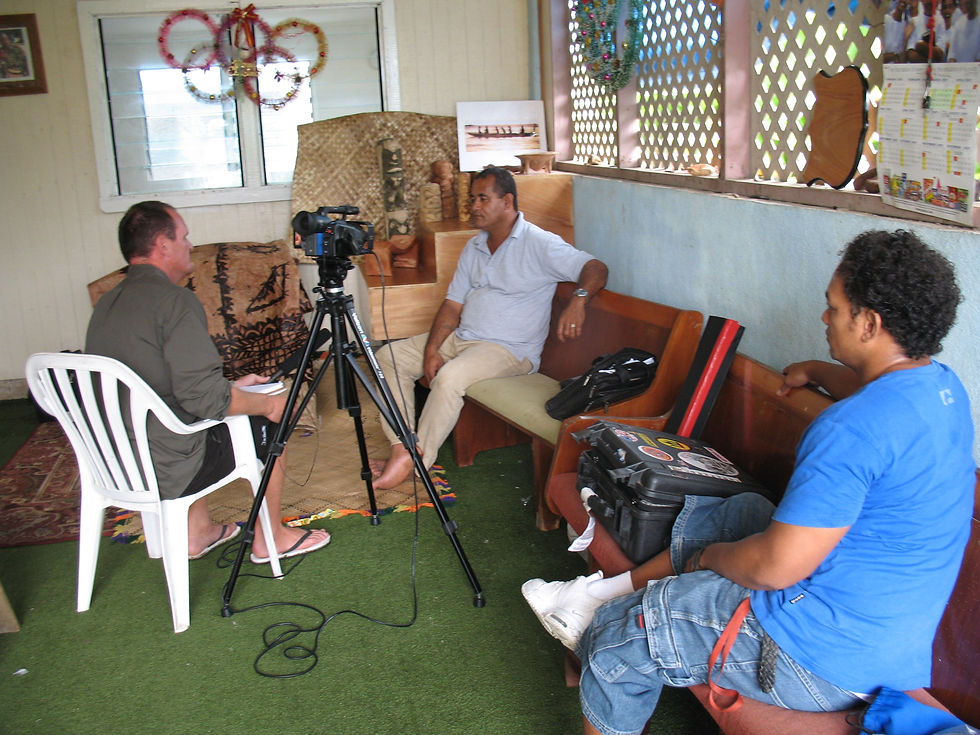
Sitting With Futa Helu
My father directed us toward one of the most important intellectual figures in modern Tonga:
Professor ‘Ilaisa Futa-‘i-Ha‘angana Helu.
Futa Helu was a philosopher, historian, educator and founder of the ‘Atenisi Institute. Contemporary academic accounts remember him as one of Tonga's most consequential twentieth-century educators and intellectuals.
We went to see him.
My brother George “Papa” Cocker assisted us during the Tonga fieldwork. Stiveni Fehoko was also part of the historical material documented during this period.
Our family opened its network to the project.
My kainga fed Jacob.
Family vehicles transported us.
Accommodation was provided through family.
My grandmother Ana was still alive.
We travelled through Tongatapu Island, including historically important areas connected to Tonga's ancient political and sacred landscape.
For me, this is important to document because a documentary is never produced only by the person operating the camera.
There is another infrastructure underneath Indigenous documentary work:
family,
food,
transportation,
translation,
introductions,
trust,
genealogy,
cultural permission,
and access.
Those resources have value.
They are part of the provenance of the work.

The Footage That Survived
The 2008 documentary was never completed in the form I expected.
Communication later became sporadic.
After years of searching, I located Jacob again through LinkedIn and resumed correspondence during 2020 and 2021.
The surviving correspondence became significant because some of the footage included my grandmother Ana, who had died by then.
Jacob informed me that some material had survived storage problems and that he could provide footage involving my grandmother. He also expressed concern about licensing and commercial use of other footage.
My response was straightforward:
My first priority was my family.
I wanted copies of footage containing my grandmother, myself and my brothers for our family archive.
I was even willing to contribute toward data recovery.
That correspondence is now itself part of the historical record of the unfinished project.
The lesson goes beyond this documentary.
Indigenous communities must think seriously about archive ownership, releases, licensing, access, preservation and chain of custody before cameras begin recording.
Cultural documentation is intellectual property.
Family memory is an asset.
And provenance matters.

There Was More Than One Tongan Tattoo Revival
The modern revival should not be reduced to a single person.
That would repeat the same historical mistake in another direction.
Several streams developed.
One involved contemporary electric tattooing, cultural research, archives, diaspora identity and the professional establishment of Tongan tattoo artists.
Another concentrated on reconstructing customary hand-tapped Tongan tātatau.
Among the important figures in that customary revival was Su‘a Sulu‘ape ‘Aisea Toetu‘u, associated with Soul Signature Tattoo and the Ta Vaka movement.
Step back into the early 2000s with this historic Polynesian Pacific Islands documentary segment from New Zealand TVNZ Network's Pacific News Tagata Pasifika, featuring 21-year-old Carl Cocker—the youngest Polynesian tattoo artist at the time—marking the beginning of a global Tongan tattoo renaissance.
At a time when Polynesian tattooing was dominated by Samoan, Māori, RaroTonga Mangaia Cook Islands, Tahitian, Marquesan, and Hawaiian tattoo artist masters, Carl Cocker aka KALia broke through as the first professionally recognized Tongan tattoo artist in New Zealand and across the Pacific regions and worldwide. https://youtu.be/DSipc5t_4Gg?si=AQcirM4r2ASNYb0Y
This rare 2002 documentary footage captures Carl Cocker’s rise among legendary Samoan tattoo tufuga tatau, Maori tattoo tamoko, Tahiti tatouage, Hawaiian tattoo kakau, and Marquesan tattoo patutiki tatouer —an era when "Tongan tattoo" was unknown as a household and in the professional scene. https://tattoonesia.blogspot.com/2008/02/
By 2006, Carl Cocker was not only the first Tongan tattoo artist to represent Tonga at the prestigious Tattoonesia Tatau i Tahiti Polynesian Tattoo Convention , hosted by the Tahiti Government and Tourism Board—but he also won 1st Place, coming just behind Japanese tattoo artist Shige. https://youtu.be/WNfzL76k0c8?si=W1n7yC4LZLU_lu00
This video—later replayed and distributed by Coconet TV in 2015—marks the beginning of a 20+ year journey. Carl Cocker continues to lead the Tongan tattoo revolution, blending ancestral storytelling with modern mastery, and has paved the way for a new generation of Polynesian artists.
thecoconet.tv is a hub for Pacific Islands moving image content online, It was funded by New Zealand NZ On Air https://www.nzonair.govt.nz/watch-and-listen/
Public documentation identifies Aisea as a major participant in the revival of customary Tongan tattoo, while Te Papa places the wider revival within a movement developing from the late 1990s and acknowledges the influence and guidance of Samoan tufuga including Su‘a Sulu‘ape Paulo II and Su‘a Sulu‘ape Alaiva‘a Petelo.

Ta Vaka's own published material records one important phase of its revival journey from October 2011 through April 2012.
Aisea Toetu'u and I had known one another years earlier 2006 through the Polynesian tattoo community. I hosted Aisea Toetu'u and his tattoo crew from Soul Signature at my home in Hawthorne after Ink & Iron Tattoo Expo 2010 when they travelled to Southern California.
I met Aisea Toetu'u in Oahu Island of Hawai‘i and visited his tattoo studio in Honolulu in 2006.

History is rarely as simple as social media later makes it appear.
People meet.
They exchange ideas.
They separate.
Different schools develop.
And eventually several versions of the same historical story compete for public attention.
The responsible solution is not to erase one another.
It is to document the timelines.

Building Tongan Tattoo Artists, Not Followers
A major part of my mission was never to create one tattoo artist who controlled every Tongan client.
The opposite.
The vision was to help establish many Tongan tattoo artists from different kainga, islands and Ha‘a, because cultural continuity requires distribution.
My personal archive records years of helping artists with tattoo machines, supplies, setup, drawing, technical knowledge, encouragement, studio development and professional direction.

Among those relationships were:
Douglas “Taki” Vea founder of Fala ‘O Niuvakai Tattoo Studio in Salt Lake City Utah, who came to Los Angeles for training and support 2008.
Vili VBone Ngata, whom I assisted with tattoo-machine setup and later trained again from my home studio, providing equipment and supplies in 2009-2010 before he worked at Frost City Utah. Vili is young brother of NFL legend Haloti Ngata.
Willy “YAMZ” Foketi, whom I advised during his developing tattoo career before he worked at Frost City Tattoo Utah.
Nia “Sinitalela” Raas, an artist who contacted me for mentorship and later worked within Northern California's tattoo community.
Tali “Tonga Rasta” Houma, whom Carl and I supported and who later travelled to Auckland to spend time with Carl at Kalia Tattoo before he works at Frost City Tattoo Utah.
Stanley Lolohea, who obtained tattoo equipment through Kalia Tattoo Studio in Papatoetoe Auckland New Zealand while developing his tattoo practice.
Kiti Vailea, who likewise connected bought his 1st tattoo machine from Carl Cocker at Kalia Tattoo Studio Papatoetoe Auckland New Zealand during the beginning of his professional development and later worked in the San Diego tattoo market.
George “Papa” Cocker, whom Carl and I trained and supplied as the Kalia Tattoo operation developed in Tonga from early 2003.
‘Ofa Tupou, who later worked within the Tonga tattoo community and tourists at Happy Sailor Tattoo.
Fautasi “Tasi” Vea, founder of Nuku'alofa Tattoo whom I assisted with equipment and supplies during later work in Tonga 2017-2018

Maikolo Mafi, founder of Culture Ink whom Carl Cocker mentored during the development of his tattoo career in Sydney Australia.
Vilisoni Kaivelata, from KanoKupolu, gave me a tattoo in 1999 in Halaleva, whom I supported indirectly through supplies carried home by my friend Tongan from Kahuku Hawaii and Kanokupolu Tane Pulotu.
I also assisted ,mentored & supported Tongan tattoo artist Maika Vaeno, John Vamanrav, Tomu Manatu, Kingi Sekona, all from Inglewood Hawthorne Los Angeles, the late artist known to me as Bou Bully in Washington, and other Tongan artists whose names I no longer have recorded after nearly three decades of tattoo work.
These stories are not included to claim ownership over another artist's later career.
They are included because mentorship itself is part of cultural history.
Someone helped somebody.
Someone supplied a machine.
Someone opened a garage.
Someone provided a couch.
Someone showed an artist how to tune equipment.
Someone made an introduction.
Someone said:
Keep going.
That network built an industry.
Orange County Southern California , San Jose San Francisco Bay Area and the Wider Polynesian Tattoo Network
The history also crossed cultural lines.
In Southern California I encountered Tongan tattoo artist Hene Ongoloka around A-Town Tattoo in Garden Grove, Orange County in 2010.
The studio was associated with Samoan tattoo artist Su‘a Sulu‘ape Si‘i Liufau, and I was present in that broader Polynesian tattoo environment when the late Samoan tufuga Su‘a Sulu‘ape Lafaele worked on traditional tattoo for my Tongan client Semisi Heimuli from Dallas Texas.
In Northern California, artists including Tongan tattoo artist Willy YAMZ Foketi and Nia Sinitalela Raas were connected with Humble Beginnings Tattoo in San Jose, founded by Filipino tattoo artist Orly Locquiao.
Carl Kalia Cocker had also interacted with Orly within the Polynesian tattoo community. Orly also invited me to work with him in his studio in 2013 but I was dedicated to another studio in Los Angeles off Sunset Blvd and Vine St.
These relationships show something that is often lost when people tell cultural histories retrospectively:
the Polynesian tattoo revival was never built inside sealed ethnic boxes.
Tongan, Samoan, Māori, Hawaiian, Filipino and other Pacific artists observed one another, learned from one another, competed with one another and sometimes disagreed with one another.
That exchange should be documented rather than hidden.
The Role of Media
Another important person in this history was my late cousin Elizabeth “2Tall” Lavulo, founder of WHATITDO dot COM
Tongan Tatatau Tattoo Documentary by WhatitDo Media 2011-2012
Before today's social-media infrastructure made everyone a broadcaster, platforms like hers created visibility for Pacific Island musicians, artists, events and cultural figures who were often ignored by mainstream US American media.
Around 2012, Elizabeth 2Tall contacted me while her production team was documenting work involving Aisea Toetu‘u of Soul Signature Tattoo Honolulu Hawaii and their Ta Vaka movement.
She discussed creating material concerning my side of the Tongan tattoo history as well.
That project did not ultimately develop as planned.
Years later, before her death in 2022, I visited Elizabeth personally when she was in poor health and helped her at her warehouse in Southern California.
Her role deserves acknowledgement because cultural movements depend not only on practitioners but also on the people who document and distribute them.
Other Voices in the Continuing Revival
The revival continued to expand.
Terje Koloamatangi has contributed significantly to contemporary discussion of tātatau faka-Tonga through practice, historical research, museum collections and Tongan oral traditions. Te Papa describes his work as centered on the revival of Tongan tātatau and documents his long engagement with the subject. https://blog.tepapa.govt.nz/2022/09/06/tongan-tattooing-reconnecting-to-fonua-across-time-and-space-through-the-art-of-tatatau/
https://fb.watch/I_hBPCnn6Z/ 2026 interview with host founder Lala Ramanlal of Radio Nuku'alofa Tonga
https://youtu.be/XfZsIzI3mQg?si=BNy3HGbCPeM2wejv 2022 Interview 531 PI Radio New Zealand
Other researchers and practitioners have entered the conversation.
That is healthy.
No living artist owns 2,700 years of Tongan civilization.
But every serious researcher has a responsibility to distinguish:
what they created,
what they reconstructed,
what they inherited,
what someone taught them,
what was documented before them,
and what remains uncertain.
That standard should apply equally to tattoo artists, academics, filmmakers and cultural organizations.
Revival Is Not the Same as Refinement
Today I make a distinction between two phases.
Tongan Tattoo Revival
The revival was about bringing Tongan tattoo back into visibility.
It required getting Tongan bodies tattooed again.
It required establishing Tongan tattoo artists.
It required confronting religious stigma.
It required entering tattoo studios and conventions.
It required creating professional value.
It required demonstrating that Tongan Tatatau cultural tattoo could exist beside Samoan Tatau, Māori Tā Moko, Hawaiian Kākau, Marquesan Patutiki and the other great tattoo traditions of Oceania.
That work belongs to many people.
Tongan Tattoo Refinement
The next stage is different.
I call it Tongan Tattoo Refinement.
Refinement asks harder questions.
Which design is genuinely documented?
Which design is contemporary?
Which motif belongs to what historical object?
Which pattern came through ngatu, lalanga, carving, weaponry, architecture, canoe technology or chiefly material culture?
What terminology is historically defensible?
How does Tohi Hohoko affect a design?
What is the client's Ha‘a?
What stories belong to the Tu‘i Tonga, Tu‘i Ha‘atakalaua or Tu‘i Kanokupolu worlds?
What belongs to Tonga—and what has been imported from Samoa, Māori art, Hawai‘i, the Marquesas or modern pan-Polynesian tattoo?
That is the research problem that interests me now.
Revival establishes existence.
Refinement establishes resolution.
Why Tongan Tātatau Is Not Simply Samoan Tatau
This is one of the most important conversations our community still needs to have.
Samoan tatau is a powerful, living and highly developed tradition.
It should be respected as Samoan.
Traditional practitioners preserved knowledge through tufuga lineages when many other Pacific tattoo systems were being suppressed.
That achievement should not be diminished.
But respecting Samoa also means not renaming Samoan structural systems as Tongan merely because the recipient is Tongan.
Likewise, contemporary Tongan machine tattoo should not automatically be described as an unbroken reconstruction of an ancient Tongan ceremony.
We need better vocabulary.
A client may be wearing:
customary reconstructed Tongan Tātatau;
contemporary Tongan cultural tattoo;
pan-Polynesian tattoo incorporating Tongan references;
or Samoan tatau received by a person of Tongan heritage.
Those distinctions do not weaken Tongan culture.
They make the historical record stronger.
From Garage Practice to Cultural Enterprise
When this work began, much Polynesian tattooing in the communities around me took place informally—in garages, homes and temporary environments.
Today cultural tattoo has international commercial value.
Artists travel.
Clients finance multi-session projects.
Tattoo work appears on professional athletes, entertainers, television, advertising and fashion.
Cultural imagery can circulate worldwide within hours.
That creates opportunity.
It also creates risk.
The next generation must understand not only tattooing but:
copyright,
licensing,
image rights,
archival ownership,
cultural provenance,
business structure,
documentation,
and intellectual property.
Our ancestors protected knowledge through social structure.
The modern world requires additional systems.
The People Behind the Modern Record
The following names represent different roles—artists, mentors, family members, researchers, filmmakers, studio owners, cultural practitioners and supporters—within the history preserved in my personal archive.
Their roles were not identical, and inclusion here does not suggest that any one person created the entire revival.
Family, Research and Early Infrastructure
King ’Afa Cocker
Carl “Kalia” Cocker
George “Papa” Cocker
Edgar Etika Cocker
Ana & Ka, my grandmother
Sione Tuione Pulotu
Professor ‘Ilaisa Futa-‘i-Ha‘angana Helu
Sitiveni Fehoko
Luisa Mahe
Tuna Fielakepa
Konai Helu
James Cocker
Houmatala Taloa
Epalahame HAME Fifita
Artists I Trained, Mentored, Supplied, Assisted or Supported by Kalia Tattoo:
Douglas “Taki” Vea
Vili VBone Ngata
Fautasi “Tasi” Vea
Willy “YAMZ” Foketi
Nia “Sinitalela” Raas

Tali “Tonga Rasta” Houma
Stanley Lolohea
Kiti Vailea
‘Ofa Tupou
Maikolo Mafi
Inny Guttenbeil
Maika Vaeno
John Vamanrav
Tomu Manatu
Kingi Sekona
Vilisoni Kaivelata
Bou Bully of Tacoma, Washington
Community, Studio and Industry Connections
Semisi Heimuli
Alani Foketi
Tane Pulotu
Koliniasi Fuko
Media, Documentation and Continuing Research
Elizabeth “2Tall” Lavulo
Paul Langi

This list will continue to be corrected and expanded as photographs, correspondence, business records, video, testimony and archival documents are organized.
History should remain open to evidence.
The Documentary Is Still Being Written
The original Tongan tattoo documentary did not become the final historical record.
Perhaps that was fortunate.
Because the story was not finished.
The revival continued through Los Angeles, Orange County, the San Francisco Bay Area, San Jose, Hawai‘i, Auckland, Sydney, Tonga, Salt Lake City, Utah County and beyond.
Artists who once needed help later trained other artists.
People who once viewed tattoo as shame began wearing cultural work proudly.
Researchers entered archives.
Museums digitized collections.
Ancient artifacts were scientifically re-examined.
The internet changed access to knowledge.
And a practice once suppressed by nineteenth-century law became visible again on Tongan bodies throughout the world.
That is not the end of the story.
It is the beginning of another stage.
The Responsibility of the Next Generation
I do not want the next generation simply to copy what my generation created.
I want them to go deeper.
Find the original object.
Find the historical drawing.
Find the museum accession record.
Speak to the elders.
Learn the language.
Understand genealogy.
Identify the Ha‘a.
Understand the political system that produced the art.
Know when something is ancient.
Know when something is reconstructed.
Know when something is contemporary.
And give credit.
A civilization does not survive because people endlessly duplicate its patterns.
It survives because people understand the systems behind them.
Tātatau is not only what we place on the skin.
It is a doorway.
Behind that doorway are the kainga, the Ha‘a, the fonua, the Tohi Hohoko, the Tukufakaholo and 3000 years of Tongan civilization.
That is the work I began pursuing before Tongan tattoo became fashionable.
And that is the work I intend to continue through the next phase:
Tongan Tattoo Refinement.

Comments