
The Return of Tatatau: A History of the Modern Tongan Tattoo Revival
Updated: Aug 12
A Timeline of Our Cultural Tattoo Journey — kingafa.com
(photos subject to copyright credit to King 'Afa)
Most of our 250,000+ Tongan people today do not understand the full journey behind the Revival of Tongan Tattoo TaTatau. This cultural revolution did not happen overnight. It comes from decades of sacrifice, mentorship, cultural work, documentation, and advocacy carried out by specific individuals inside and outside the Kingdom of Tonga. This is the timeline.
The Samoan Tatau Lineage That Shaped the Pacific Islands Tattoo Revival
The late Sua Suluape Paulo, the Samoan tatau legend, is one of the most important figures in the history of Pacific tattoo. Sua Paulo Suluape was responsible for taking Polynesian tattooing to the world stage—appearing in New Zealand media and European media in the 1980s and 1990s, teaching traditional Samoan tatau internationally, and inspiring hundreds of tattoo artists across the world.
Su'a Paulo Suluape tragically passed away in 1999. Out of respect for his aiga Samoa and the Suluape name, we acknowledge his tragic death with dignity. His contribution must always be remembered with honor. Read more here.
After Sua Paulo Suluape’s tragic demise, his younger brother, Samoan tatau master Sua Suluape Alaiva'a Petelo, continued the Suluape tatau legacy. Sua Petelo Suluape later trained his son, Sua Suluape Peter, who carried this traditional Samoan tatau lineage into the modern era. Watch more about this legacy.
In 2011, Sua Peter Suluape was a guest tattoo artist at Kalia Tattoo when he visited Auckland New Zealand. He gifted a tatatau to Carl Kalia, honoring the cultural relationship between Samoa and Tonga. Papa George was introduced to Sua Peter Suluape by Carl Kalia at the New Zealand Indigenous Tattoo Convention.
In 2019, the Sua Petelo Suluape family invited George “Papa” Cocker and his wife to a feast in Samoa while attending the Pacific Games in Samoa. This event honored Carl Kalia’s friendship and acknowledged our Tongan tattoo family’s contribution to the revival of Pacific Islands tattoo.
Their friendship strengthened the connection between our two tattooing traditions. Historically, the Suluape family comes from Samoan aiga tufuga tatau who tattooed Tongans in ancient times. Records show Tongan men were still traveling to Samoa to receive tatatau into the 1800s and early 1900s. This is why the Suluape name is culturally connected to Tongan tattoo history.
The Beginning of the Modern Tongan Revival (1997–2006)
In 1997, Māori tā moko artist Inia Taylor, trained by Paulo Suluape, opened Moko Ink, the first Polynesian tattoo shop in New Zealand owned by a Māori tattoo artist. Inia Taylor was the Assistant Art Director of the 1994 New Zealand Film Once Were Warriors.
From 2003 – 2006, Carl Kalia Cocker trained under Inia Taylor at Moko Ink, learning both Māori tāmoko tattoo art and the Samoan tatau art lineage of the Suluape family. !Tongan Tattoo Kalia Tattoo Tongan Kupesi Carl Kalia Cocker
In 2005, I traveled to Auckland, New Zealand, to train and mentor Carl Kalia and Inia Taylor at Moko Ink in Grey Lynn Auckland. This experience became part of the cultural lineage and foundation for the revival of Tongan tattoo.
The Return of Tatatau: A History of the Modern Tongan Tattoo Revival
How a generation of Tongan artists — working from Los Angeles to Auckland — brought a suppressed art form back to life
In November 2006, Tonga was in flames. Riots tore through Nuku'alofa as a pro-democracy movement forced a reckoning with a centuries-old monarchy, and the eyes of the Pacific Islands nations turned toward a small kingdom in crisis. I flew into Tonga four months later, in March 2007 — not to cover the political riot unrest, but to begin a quieter kind of work: bringing back an art form the Kingdom itself had once outlawed.
That art form Tukufakaholo was Tatatau, Tongan tattoo. It had been outlawed since 1839, when mordern Kingdom of Tonga; King Tupou I's first legal code — written under political European England British Empire Constitutional influence — suppressed tattoo practiced of TaTatau, Tatau & Kakau across the new Kingdom of Tonga. For more than 160 years, Tongan tattoo went silent. Samoan tatau survived through an unbroken line of tufuga, master artists practitioners. Māori Tā Moko found its way back through cultural reclamation in the 20th century. Tongan tattoo had almost nothing — no living lineage of artists Tufunga, no established market, and by 2006, barely any visible presence at all. You could watch hours of footage from that year's 2006 Tonga Riots and not find a single young Tongan man with a forearm sleeve, let alone a full one.
Learning Before There Was a Market
My own path into tattooing started before there was any real market for it. In 1996 and 1997, while still in high school, I designed art that friends and I wore for cultural performances — work that would later become permanent, tattooed pieces. I received my own first tattoos in Tonga in 1998 and 1999, though none of it was yet the clan-based cultural work I do today; that came later, through years of research into Kolo Tupu'anga (village of origin), Ha'a (clan), and Tohi Hohoko (genealogy) that most Tongan tattoo simply didn't reference at the time.
That distinction still matters, and it's one most people outside the craft don't fully understand: there's a difference between a historian who studies Tongan culture from a classroom and someone trained in Tukufakaholo — Tonga's living system of historical and cultural knowledge, passed down and practiced, not just researched and footnoted. I was trained the second way, by elders in Tonga who held that knowledge directly. It shapes every design I build today
The 2006 Tahiti Breakthrough — Tongan Representation Begins
In 2006, Carl Kalia Cocker represented Tonga at the Tattoonesia Tatau i Tahiti Polynesian Tattoo Convention—the largest tattoo event in the Pacific Islands region. There were no other Tongan tattoo artists present. At only 25 years old, Carl won 1st Place Overall after Japanese Tattoo Artist Shige https://www.instagram.com/shige_yellowblaze/?hl=en https://yellowblaze.net/ bringing global attention to Tongan Tattoo Culture for the first time in the tattoo industry. This moment helped establish Tongan tattoo as a respected style worldwide. ! Tongan Tattoo Kalia Tattoo Tongan Kupesi Carl Cocker Brisbane Australia
A Parallel Revival in the Southern Hemisphere
While I was building that market in Los Angeles and across California, my brother, Carl Kalia Cocker, was doing the same work eight thousand miles south. From 2002 to 2006, Carl Kalia trained at Moko Ink in Auckland under Māori Tā Moko Tohunga artist Inia Taylor — himself trained by the Samoan tatau master Sua Suluape Paulo — learning both Māori and Samoan tattooing traditions from the inside. In 2005, I traveled to Auckland myself to train and mentor at Moko Ink, adding to a lineage that would become the foundation of the modern Tongan tattoo movement.
In 2006, at just 25 years old, Carl represented Tonga at the Tattoonesia Tatau i Tahiti convention — the largest Polynesian tattoo event in the Pacific — and won first place overall. No other Tongan artist was present at that convention; it was the first time Tongan tattoo had registered on the world stage. Four years later, Carl won the Sydney Tattoo Expo with a Fijian masi chest piece, becoming the first artist to tattoo a Fijian masi design on a Fijian client in the modern era — a moment credited with sparking the Fijian tattoo renaissance that followed.
In 2009, Carl founded Kalia Tattoo in Papatoetoe, Auckland: the first Tongan-owned tattoo studio in New Zealand, Australia, and the Southern Hemisphere. It became a training ground for the next generation of Pacific tattoo artists.
Building a Market Where None Existed
By 2006, tattooing among Tongans — in Tonga and across the diaspora — carried almost no commercial or cultural value. Work was traded for a case of beer or a carton of cigarettes as often as it was paid for in cash. That year 2006, I became the first Tongan tattoo artist in the United States to hold a professional, W-2 position at a tattoo studio — Zulu Tattoo, on 3rd Street near Crescent Heights in the Hollywood/Beverly Hills corridor of Los Angeles — earning US$200/hour at a time when most Polynesian tattoo work in the U.S. was still happening out of garages.
Building real value meant more than raising prices. It meant establishing cultural protocols, refining traditional styles into a coherent design practice, and teaching clients — Tongan, Samoan, Fijian, Hawaiian, Filipino, and beyond — the real differences between Tongan, Samoan, Fijian, Māori, Micronesian, and Melanesian tattoo traditions, instead of letting them blur into one another. Today, tattoo artists working in Tonga can charge TOP$200–$1,200 for a forearm sleeve. That market didn't exist twenty years ago. It had to be built.
Creating Cultural & Economic Value (2000s–2010s)
Carl Kalia attended numerous tattoo conventions across New Zealand and Australia, winning awards and elevating the cultural and commercial value of Tongan tattoo. In 2010, he revived Fijian tattoo by winning the Sydney Tattoo Expo with a Fijian masi chest tattoo. This was the first time modern Fijian people saw a Fijian masi tattooed on a Fijian person. This moment marked the beginning of the modern Fijian tattoo renaissance.
The first ten years (2000–2010) were foundational. I created a new price structure, introduced cultural tattoo protocols, refined traditional art styles, and educated clients on the differences between authentic Tongan, Samoan, Fijian, Māori, Micronesian, and Melanesian art. !
In 2006, I became the first Tongan tattoo artist in the United States to officially work in a professional tattoo studio with a W-2 paycheck, earning USD$200 an hour at Zulu Tattoo in the Hollywood/Beverly Hills area. At that time, every other Polynesian tattoo artist was still charging garage-sale tattoos. The value of a Tongan tattoo was often reduced to a box of cigarettes and a case of beer.
I had to create value from the garage-sale market, and my pricing forced the entire Polynesian tattoo market in the U.S. to rise. We established a price point for the Polynesian and Tongan tattoo markets. !
While I built value in the Northern Hemisphere, my brother Carl KĀLIA Cocker was doing the same in the Southern Hemisphere. Together, we built the Tongan Tattoo Renaissance. Today, Tongan tattoo artists in Tonga charge TOP$200–TOP$1,200 for forearm sleeves—prices that could never exist without the 20 years of foundation we built.
Tattooing has become a legitimate career in Tonga, supported by tourism, Tongan diaspora clients, and cultural demand. However, in the early 2000s, none of this existed. The negative stigma was strong, there was no local market, and nobody believed tattooing could be profitable or respected.
The First Tongan-Owned Tattoo Shop in NZ, Australia & the Southern Hemisphere (2009)
In 2009, Carl Kalia officially founded Kalia Tattoo in Papatoetoe, Auckland—the first Pacific Island Polynesian tattoo studio in New Zealand, Australia, and the entire Southern Hemisphere owned and operated by a Tongan tattoo artist. Visit Kalia Tattoo. This legal tattoo studio became the center of Tongan tattoo innovation, training, and mentorship for years to come. !Tongan tattoo kalia tattoo george papa cocker tonga kupesi tatatau
Making Tattoo Business Legal in Tonga — The First Licensed Tattoo Business (2011)
Tongan Tatatau and all tattooing were outlawed in Tonga in 1839 under Taufaahau King Tupou I’s first legal code. For over 160 years, Tongan tattooing existed underground. !
In 2011, for the first time in Tongan history, a tattoo business was officially registered. George Papa was operating a tattoo from home in 2009, but it was never registered with the Tonga Government. Carl Kalia encouraged George Papa to pay TOP$600 to register Kalia Tattoo in Tonga in 2011. Initially hesitant, George Papa did not believe that tattooing could be a viable business in Tonga.
King 'Afa and Carl Kalia recognized the market potential and cultural responsibility to bring tattoo culture back into the Kingdom as a legal private sector and fine art. George Papa later met with the Tonga Ministry of Tourism to recognize tattooing as cultural tourism. As a result, Kalia Tattoo has been featured in the Tonga Visitors Bureau brochure for several years.
King ‘Afa and Carl Kalia supplied tattoo ink, needles, knowledge, and supplies for Papa George Kalia Tattoo Tonga from 2009 to 2022. !Tongan tattoo kingafa tonga tatatau kupesi kalia tattoo
MakingTattoo Business Legal In Tonga
Tattooing in Tonga carried the weight of nearly two centuries of prohibition, and even after the culture began shifting, the business itself remained informal — my brother George "Papa" Cocker was tattooing out of his home as early as 2009, unregistered with the Tongan government. In 2011, Carl encouraged him to formalize it. For TOP$600, George registered Kalia Tattoo with the Kingdom of Tonga — the first officially licensed tattoo business in Tongan history. Carl Kalia Cocker and I supplied that studio with ink, needles, and equipment for over a decade, from 2009 to 2022.
That formal recognition opened doors. Papa George later worked with Tonga's Ministry of Tourism to have tattooing recognized as a form of cultural tourism, and Kalia Tattoo has since been featured in the Tonga Visitors Bureau's own promotional materials — a full turn from a practice the Kingdom's own laws had once criminalized.
The First Tongan Tattoo Website (2002)
Carl Kalia registered TonganTattoo.com in 2002—the first Tongan tattoo website in the world. King ‘Afa registered PolynesianTribalTattoo.com in 2006, and developed, designed, and launched kaliatattoo.com and kingafa.com in 2024. This platform preserved, archived, and shared Tongan Tattoo history, art, and culture.
Carrying the Work Forward
None of this survives as a revival if it stops with one generation. Over the past two decades, I've trained, mentored, or equipped Tongan tattoo artists across the diaspora — often for free, because the point was never to gatekeep the work, it was to grow it.
In the Los Angeles and Orange County area, that's meant training and supporting artists like Willy "Yamz" Foketi and Maika Vaeno Tava in Inglewood, John Vamanrav and Mathaias Vanisi out of Hawthorne, Tomasi Manuatu in Moreno Valley, Feti Unga in Rancho Cucamonga, Kingi Sekona, and Hene Ongoloka, who came up through A-Town Tattoo in Garden Grove. In the San Francisco Bay Area, it's artists like Nia "Sinitalela" Raas in Sacramento and the crew who came through Humble Beginning Tattoo in San Jose.
In Salt Lake City and Utah County, it's Taki Vea of Fala-o-Niuvakai — the first professional Tongan tattoo artist in the state — who trained with me in Los Angeles for a week in 2008 before returning home to build his own practice; Vili Ngata, who I trained and equipped in 2009 and 2010 and who went on to work at Frost City in Midvale before his passing in 2022 from an overdose, a loss still felt by the community he helped build; and Tali "Tonga Rasta" Houma, who trained with Carl Cocker at Kalia Tattoo in 2014 in Auckland before coming home to work at Frost City himself.
The network reaches further still: Sam Taungakava of Steadfast Art Collective in Seattle Washington State; the late Bully in Tacoma, who I also mentored before his passing in 2020;
Stanley Lolohea, who bought his first machine from Kalia Tattoo;
Kiti Vailea, who did the same bought his 1st professional tattoo machine from Kalia Tattoo with carl Kalia before eventually landing at Friendly Island Tattoo Studio in San Diego;
Maikolo Mafi, trained by Carl in 2009 and now running Culture Ink in Sydney;
Mana Fifita, carrying the work as far as Doko Ink in Germany;
Back in Tonga, Vilisoni Kaivelata in Kanokupolu carries the tradition forward, and Fautasi "Tasi" Vea — who I traveled to Tonga to support in 2017 — built what's now Nukualofa Tattoo, since passed to fellow artist Taleta Maka as Otu Felenite Tattoo.
George Papa, meanwhile, trained the next generation working out of Touliki village, including Tongan Tattoo artist ʻOfa Tupou at Happy Sailor Tattoo in Nukualofa Capital Tonga , and helped artists like British James of Happy Sailor Tattoo get properly licensed establaished in Tonga
The line runs in one direction: from Samoan tatau masters, through Māori Tā Moko, into the Tongan Tattoo Revival, and out into a generation of Pacific Island tattoo artists who never had to build the market from nothing, because that work had already been done for them.
Training & Mentoring the Tongan Tattoo Community (2008–2022)
George “Papa” Cocker’s Training (2008–2009)
Carl Kalia sponsored and mentored Papa George at Kalia Tattoo in New Zealand after the official launch of Kalia Tattoo in 2009. Papa George later mentored several Tongan tattoo artists, including:
ʻOfa Tupou (Happy Sailor Tattoo, Nukualofa, Tonga) https://www.instagram.com/tupouofa/
James (founder of Happy Sailor Tattoo Tonga ) who rented our home in Houmakelikao Maufanga from 2016 to 2017. https://www.facebook.com/Happysailortattootonga
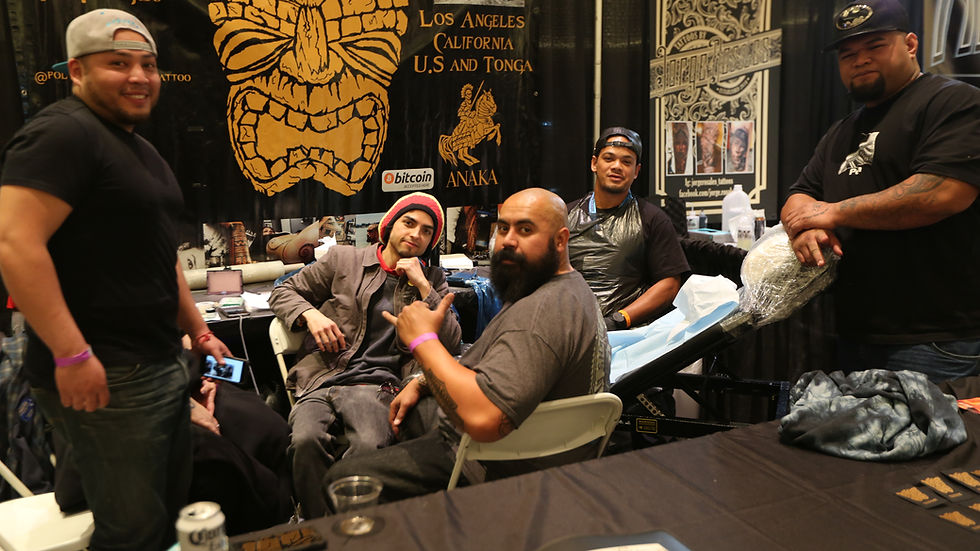
King ‘Afa Contributions to Tongan Tattoo: Tattoo Artists Inspired, Mentored, or Trained, supplied free tattoo supplies + free tattoo training:
Trained twice, mentored, and gifted a tattoo machine and equipment—free of charge—to Tongan tattoo artist Vili Ngata (2009 - 2010). https://www.instagram.com/v_ngata/ Vili later worked at Frost City in Midvale South Salt Lake City, Utah, but sadly passed away in 2022 from a drug overdose.
Polynesian Tongan Pioneer Tattoo artist Taki Vea of Fala-o-NiuVakai Tattoo Studio - Salt Lake Utah (2008) Visit Fala-o-NiuVakai. Taki Vea is the 1st Professional Tongan Tattoo Artist in the State of Utah.
King ‘Afa and Carl Kalia Cocker mentored and provided tattoo equipment for Tongan tattoo artist Fautasi Vea (Tasi Waiouru Tatatau) - Melbourne, Australia, founder of Nukualofa Tattoo Shop (2017) https://www.instagram.com/tasiwaiourutattoo/
now operated as Otu Felenite Tattoo and Barbershop by Tongan tattoo artist Taleta Maka Visit Taleta Maka.
Numerous other artists have been inspired and mentored through our efforts, including:
Willy YAMZ Foketi ( 2009 ) who joined Frost City at Midvale South Salt Lake City before worked at Humble Beginning Tattoo in San Jose Bay Area California https://www.instagram.com/yamz5700/
Nia Sinitalela Raas (2010) Sacramento https://www.instagram.com/sinitalela/
Tomasi TOMU Manuatu (2010) - Moreno Valley Southern California
Samoan Tattoo artist Pe’a Man (2017) https://www.instagram.com/pe.aman685/
Sam Taungakava - Steadfast Art Collective - Seattle Washington - 2010 https://www.instagram.com/sam_tattoo/
Bou Bully (RIP) - Tacoma Washington 2020
Maika Vaeno Tava (Inglewood, Los Angeles) 2009
Feti Unga (Rancho Cucamonga, Southern California - Las Vegas)
John Vamanral ( Hawthorne Southern California Los Angeles - Utah ) 2008
Mathaias Vanisi ( El Segundo/ Hawthorne Southern California Los Angeles - Utah) 2007
Ludwig Hettigg ( New Zealand )

Preserving the Record
Reviving a practice this old also meant documenting it. From 2006 to 2008, I spent time researching Tongan cultural artifacts at the Tonga Museum and National Centre, photographing pieces connected to Tatatau history — traditional wooden kali (headrests), Lapita-era tattoo chisels, and a rare 1826 sketch of Tongan tatau drawn during contact between French explorer Jules Dumont d'Urville and the Tongan chiefs of Pea, one of the earliest known European documentations of Tongan tattoo culture.
In 2008, I extended that work further: recorded interviews across Tonga and New Zealand, including a conversation with the late philosopher and Atenisi Institute founder Futa Helu, as part of an early effort to document this history on film.
That research sits alongside a genuinely remarkable archaeological find. In 2019, researchers from Griffith University and the Australian National University confirmed that a set of bone tattooing combs excavated in Tonga in the 1960s were roughly 2,700 years old — making them the oldest confirmed tattooing tools in Oceania, and among the oldest complete tattoo kits ever discovered anywhere in the world. It's the kind of find that reframes the whole conversation: Tongan tattoo isn't a trend catching up to Samoan or Māori tattoo's visibility. It's one of the oldest tattooing traditions on Earth, and for over 160 years, it simply wasn't allowed to be practiced.
What This Work Is For
This work has cost me more than time. I've faced targeted violence at my own home — moments when my son and the people closest to me were inside while it happened. I chose to build instead of retaliate. Everything I've made since is proof that was the right call.
Where This Stands Today
Tongan tattoo today is a legitimate, respected practice — supported by tourism, sought out by the diaspora, and finally free of the stigma that surrounded it a generation ago. That didn't happen by accident, and it didn't happen quickly. It took two decades of building market value where there was none, training artists who had nowhere else to learn, and doing the research to make sure the designs coming out of this revival were actually rooted in Kolo Tupu'anga, Ha'a, and Tohi Hohoko — not a generic, flattened version of "Polynesian tattoo" built for trend rather than lineage.
That's still the work. Every custom piece starts with a client's actual village, clan, and genealogy — not a stencil pulled off a wall.
Tongan Tattoo Artists Who Inspired King ‘Afa and Carl Kalia (1990s)
Piliote Vea (Haʻateiho Tongatapu) Visit Piliote Vea.
Duke "Tiuke" Tukuafu (Houmakelikao, Maufanga Tongatapu) Visit Duke Tukuafu.
Vilisoni Kaivelata (Kanokupolu Hihifo Tongatapu) tattooed King 'Afa in 1999 in Halaleva TongaTapu with childhood friend Soni Vaka.
Introducing Tongan Artists from Tonga to the Tattoo Industry (2011)
George “Papa” attended his first tattoo convention at the Kalia Tattoo booth in New Zealand in 2011, alongside Carl Kalia. This was his first exposure to the global tattoo industry and convention culture.
11. The Impact of This Movement
This revival has:
Opened the tattoo market in Tonga
Created economic opportunities for Tongan artists
Reestablished Tongan cultural pride
Connected Tongan tattoo to Samoan, Fijian, Māori, and Micronesian lineages
Restored Tongan Tattoo not Tongan Tatatau after 160 years of suppression
Built a new generation of Tongan tattoo professionals
Established legal and commercial pathways never seen before in Tonga
This is the genealogy of influence:
Sua Paulo Suluape (Suluape Tatau Samoa) → Inia Taylor (Moko Ink NZ) → Carl Kalia (Kalia Tattoo NZ & Australia) + King ‘Afa (Kalia Tattoo Los Angeles US) → George Papa (Kalia Tattoo Touliki Tonga) + Mana Fifita (Doko Ink - Germany) + Maikolo Mafi (Culture Ink - Sydney NSW Australia) + Tasi Waiouru (Melbourne) Australia + Taleta Maka (Otu Felenite Tattoo Nukualofa Tonga) + Taki Vea (Fala-O-Niuvakai SLC Utah USA) + Stanley Lolohea (NZ) + Terje Koloamatangi (Small Axe Studio NZ) + Matiah Koloamatangi (Small Axe Studio NZ) → the next generation.
This is how Tongan tattoo returned to the world.

Media, Documentary Research & Attempts to Document the Modern Tongan Tattoo Movement
Paul M. Langi — Tongan filmmaker who approached King ‘Afa in July 2025 seeking a paid Tongan Tātatau consultation and proposing King ‘Afa as a principal tattoo and historical subject for a planned documentary. Langi also expressed interest in interviewing Carl “Kalia” Cocker after independently researching his earlier work. The proposed project remained in development during the documented correspondence.
For Education & Cultural Reference
Authentic Polynesian Tattoos, Tongan tattoo, Pacific Island art, and contemporary tribal art:
🌐 kaliatattoo.com – Brisbane & Sydney, Australia
🌐 kingafa.com – West Los Angeles & San Jose + San Francisco Bay Area, California
Our mission has always been to preserve the integrity of Polynesian Tattoo art, create value and market for Polynesian Tattoo, Tongan Tattoo, Micronesian Tattoo, Fijian Tattoo, and now refined Tongan tattoo cultural art without the practice of the traditional ancient Tongan Tatatau, leaving that sacred ritual tradition for Samoan Tufuga Tatau artists.

Comments